Picking the Right Protection: Polyethylene Foam vs. Silicone Rubber vs. PVC (A Buyer's Guide from Someone Who's Botched All Three)
-
There's No "Best" Material. Only a "Best Fit" (Trust Me, I Learned This the Hard Way)
-
What Determines the Right Material? (The Non-Obvious Factor)
- Scenario A: High-Protection, Low-Volume, or Temperature-Sensitive Items → Sealed Air Polyethylene Foam
- Scenario B: High-Temperature, Conformal Sealing, or Precision Vibration Dampening → Silicone Foam Rubbers
- Scenario C: Rigid Support, Structural Applications, or Cost Priority → PVC Plastic (With Caveats)
-
Decision Framework: How to Choose Your Material (Step by Step)
-
Final Thoughts (and a Reality Check)
There's No "Best" Material. Only a "Best Fit" (Trust Me, I Learned This the Hard Way)
If you land on this page hoping for a single answer—like "Sealed Air foam is always the way to go"—I'm going to disappoint you. Because over the past eight years handling packaging orders for a mid-sized electronics contract manufacturer, I've learned that the right material depends entirely on what you're protecting, where it's going, and who's signing the check.
I didn't get this from a textbook. I got it from a $3,200 order of sensitive circuit boards that arrived shattered because I assumed silicone rubber was the best shock absorber (spoiler: it wasn't for that application). And from a client who rejected a shipment of custom-cut Sealed Air foam sheets because they were too bulky for their storage space. And from a compliance report that flagged a PVC component I'd specified for a RoHS-regulated product.
The trigger event that changed my approach was a vendor failure in March 2023. I'd specified silicone foam rubbers for a batch of 500 assemblies headed to a medical device client. The material itself was fine—on paper. But it was over twice the required hardness, providing virtually no vibration dampening. The client sent back 487 units. $890 in redo material, a one-week delay, and a lot of humility.
Since then, I've systematized how I choose between the big three: polyethylene (PE) foam like Sealed Air's Cell-Aire, silicone rubbers, and PVC. This article breaks down the decision framework I now use—and the mistakes you don't have to repeat.
What Determines the Right Material? (The Non-Obvious Factor)
Before I walk through specific scenarios, here's the mental shift that helped me: stop thinking about materials first. Instead, start by defining three things about your application:
- The environment — temperature range, chemical exposure, UV, cleanliness requirements
- The fragility profile — is it a 50g ceramic sensor or a 5kg steel bracket?
- The budget + timeline — not just material cost, but total cost including tooling, minimum order quantities, and lead time
When I lined up our Q1 and Q2 projects side by side using this framework, I realized something uncomfortable: we'd been using silicone for at least 30% of projects where PE foam would have worked better—and cost half as much. So let's look at the three main scenarios.
Scenario A: High-Protection, Low-Volume, or Temperature-Sensitive Items → Sealed Air Polyethylene Foam
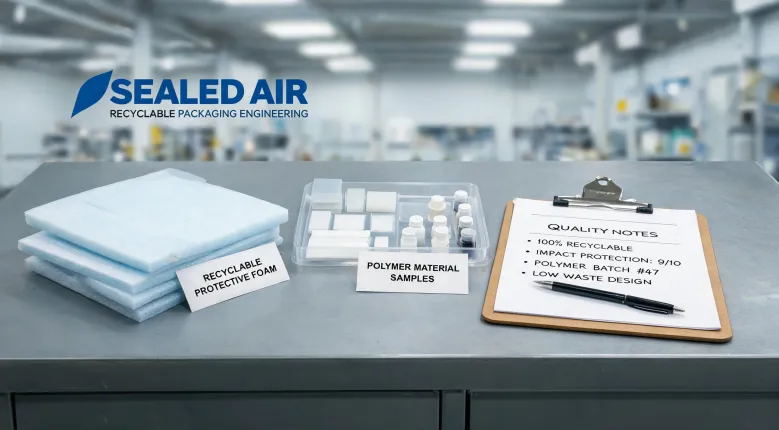
This is the workhorse of protective packaging, and Sealed Air's Cell-Aire foam is the most specified product I've dealt with. Here's when I lean on it.
When It Shines
- Fragile, medium-weight items (0.1–5 kg) — electronics, glass, precision tools. Its closed-cell structure provides consistent, predictable cushioning.
- Temperature range -60°C to +80°C — fine for most shipping environments, but not for extreme heat.
- Low-volume runs or custom shapes — Sealed Air foam sheets can be cut, layered, or die-cut. Minimum order quantities are usually lower than silicone molding.
- Cost-sensitive projects — Material is usually 30–50% cheaper than silicone rubber alternatives.
Where I've Seen It Fail (My Mistakes)
- High-temperature environments. I once used Sealed Air foam for packaging components stored near a furnace. The foam softened and lost its cushioning. The lesson: stay below the 80°C threshold.
- Heavy, dense items. PE foam is great for shock absorption, but it can bottom out under sustained pressure. For items over 10 kg, consider a different approach.
- Applications requiring flame resistance. Standard PE foam is not inherently flame-retardant. Specialized grades exist, but you must specify them.
Surprise insight: The biggest mistake most people make is over-specifying foam. A 10mm sheet might be overkill for a 200g component, wasting space and money. A 3mm sheet with proper fitment often works just as well.
Scenario B: High-Temperature, Conformal Sealing, or Precision Vibration Dampening → Silicone Foam Rubbers
Silicone foam rubbers and silicone rubber sheets are a different beast. They're more expensive, but they solve problems PE foam can't touch.
When to Use Them
- High-heat environments (up to 200°C+) — engine compartments, lighting fixtures, industrial equipment.
- Sealing and gasketing applications — because silicone rubber sheets offer excellent compressibility and rebound, they seal better than PE foam.
- Low-temperature flexibility (down to -57°C) — far better than PVC, which becomes brittle in extreme cold.
- Cleanroom or medical applications — silicone is inherently biocompatible and resists microbial growth.
The Downside (Which Cost Me a Client)
Memory and cost. Silicone foam has excellent compression set resistance—meaning it returns to shape after being compressed. That's great for gaskets. But for one-time cushioning, it's over-engineered and expensive. The failed medical device order I mentioned earlier was a classic case: we paid for premium vibration damping, but the hardness (60 Shore A) was too high for the delicate components. A softer PE foam would have absorbed the energy better at half the cost.
Never expected hardness to be the deal-breaker. But it was. So if you're using silicone foam for cushioning, pay extremely close attention to the durometer rating. Lower Shore A (softer) is usually better for shock absorption.
Scenario C: Rigid Support, Structural Applications, or Cost Priority → PVC Plastic (With Caveats)
PVC is often misunderstood. People think it's just cheap plastic. It's not—it's a structural material with real limitations. Here's when it works, and when it doesn't.
When I Consider PVC
- Rigid separators, dividers, or inside-box structures — where shape retention and stacking strength matter.
- Applications where cost is the dominant factor — PVC is often 30–60% cheaper than silicone rubber per unit area.
- Non-outdoor, non-extreme temperature use (roughly -10°C to +60°C).
My Painful Lessons with PVC
- Compliance issues. PVC contains chlorine-based compounds. In a RoHS-regulated product, I once specified a PVC sheet that failed due to phthalate content. The re-spec cost us $1,200 and a 2-week delay. If you're shipping to the EU, California, or medical markets, assume PVC needs extra due diligence.
- Brittleness. PVC becomes brittle below about -10°C. If your shipment goes through a frozen warehouse—hello, cracked dividers.
- It's not a cushioning material. I've seen people try to use PVC foam (like foamcore) for shock absorption. It doesn't compress well. For cushioning, stick with PE or silicone.
Avoid this mistake: Don't default to PVC just because it's cheap. The total cost of a compliance failure can be 10x the material savings.
Decision Framework: How to Choose Your Material (Step by Step)
Here's the process I now use for every new project. It takes about 30 minutes and has prevented at least 15 specification errors in the past 18 months.
- Temperature check. Operating range above 80°C or below -20°C? → Silicone rubber. Between -20°C and 80°C? → Any material is possible.
- Function check. Primary need is cushioning (shock absorption)? → PE foam. Primary need is sealing or gasketing? → Silicone rubber. Primary need is structural support? → PVC.
- Compliance check. Any RoHS, REACH, FDA, or similar requirements? If yes, PVC is a yellow flag. Verify certifications with your supplier.
- Cost check. Compare per-unit material cost plus tooling, minimum order quantities, and assembly time. I've seen projects where the 'cheaper' material cost more because of higher waste or manual labor.
- Test prototype. This is non-negotiable. Get a sample of the material, cut it to fit, and drop-test your product. The ISTA 1A standard is a good baseline for most packages.
Final Thoughts (and a Reality Check)
The secret isn't finding the "perfect" material. It's knowing the limitations of your chosen material better than you know its strengths. The best solution for an order I handled in Q3 2024 was a combination: Sealed Air foam for cushioning, with a thin silicone gasket for a heat-sensitive component. Using only foam would have failed the heat requirement. Using only silicone would have blown the budget.
If you're at the beginning of your packaging spec process, start by visiting the Sealed Air official website to check their product data sheets. But don't stop there. Ask your supplier for hardness ratings, temperature limits, and compliance certifications. A good supplier will share this. A bad one won't—and that's your first red flag.
Pricing note: Costs mentioned are based on quotes I received in March 2025. Actual prices vary by volume, customization, and market fluctuations. Always verify current rates with your vendor.

Jane Smith
I’m Jane Smith, a senior content writer with over 15 years of experience in the packaging and printing industry. I specialize in writing about the latest trends, technologies, and best practices in packaging design, sustainability, and printing techniques. My goal is to help businesses understand complex printing processes and design solutions that enhance both product packaging and brand visibility.
Leave a Reply