EPE Foam vs. Custom Polyurethane Foam: Which is Best for Your Protective Packaging?
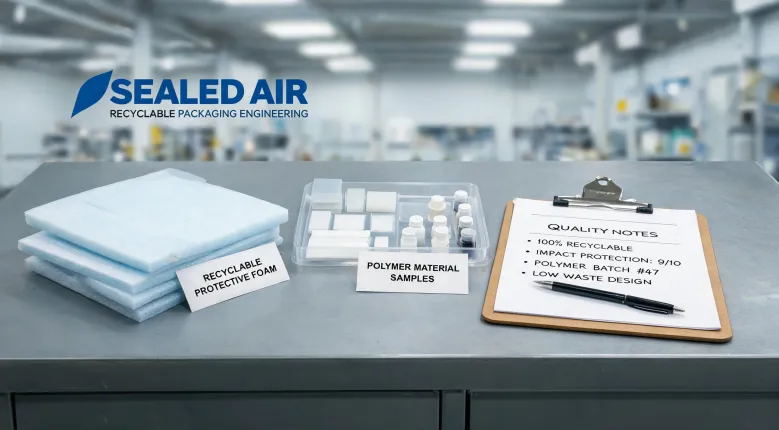
If you're sourcing protective packaging—especially for fragile items or tight deadlines—you've probably run into the endless debate: EPE foam or custom polyurethane foam? Both are popular, but they serve very different purposes.
I'm not a material scientist, so I can't speak to the molecular structure or thermal properties in great depth. What I can tell you, from coordinating hundreds of rush orders for things like medical devices, electronics, and event materials, is how these two options behave when the pressure's on. Let's break it down by the dimensions that actually matter in a real supply chain.
The Core Framework: What We're Comparing
Before diving in, let me clarify the two options at play here:
- EPE (Expanded Polyethylene) Foam—often referred to under the brand Cell-Aire from Sealed Air. It's a lightweight, closed-cell foam, usually available in sheets or rolls. Think of the soft, slightly springy foam that comes wrapped around electronics.
- Custom Polyurethane (PU) Foam—the more rigid, often denser foam that's poured into molds to create custom fit shapes for specific products. It's what you see in high-end protective cases or for heavy industrial parts.
The comparison here isn't about which is 'better' overall. It's about which solves your specific problem faster, cheaper, and more reliably. We'll look at three key dimensions: material density & protection, tooling & lead time, and cost structure at different order sizes.
Dimension 1: Density & Compression Resistance
EPE Foam is generally low-density. Standard grades range from 1.2 to 2.5 pounds per cubic foot (PCF). It provides excellent shock absorption for light-to-medium weight items, but it compresses noticeably under sustained pressure. For a product like a delicate sensor that weighs 2 pounds, EPE is perfect. For a 50-pound piece of machinery? Not so much.
Custom PU Foam can be formulated from ultra-soft (1 PCF) to extremely rigid (8 PCF or more). This is where customization shines. You specify the exact compression curve. The downside? If you over-specify density, you're paying for material that your product doesn't need.
The surprise here: I once sourced EPE for a heavy electronic assembly because I assumed PU would be overkill. My first year, I made the classic specification error—assuming 'standard' meant the same thing to every vendor. The EPE bottomed out in transit. Cost me a $600 redo and a pissed-off client.
Conclusion for this dimension: If your product is under 15 pounds and not sharp-edged, EPE is usually sufficient. For anything heavier or with point loads, custom PU is safer. Period.
Dimension 2: Tooling, Setup & Lead Time
This is often the deciding factor, especially when you're up against a deadline.
EPE Foam requires minimal tooling. For simple die-cut shapes (circles, squares, basic contours), you're looking at a die cost of $100-$400 for a steel-rule die. Lead time for the die is typically 3-5 business days. If you're buying standard sheets, same-day shipping is possible from some distributors. In March 2024, I had a client call at 10 AM needing foam inserts for 200 kits by the next morning. Normal turnaround is 3 days. We sourced EPE sheets same-day, cut them on a CNC in-house, and delivered by 7 PM. Total rush fee: $80 extra on a $420 order. The client's alternative was missing a trade show.
Custom PU Foam is a different beast. Pour molds are expensive. A simple mold for a single product cavity can run $500-$2,000+. Lead times for mold creation: 2-4 weeks minimum. Rushing that is possible but comes at a steep premium—think $300-$500 extra for 1-week turn on the mold. Then you still need to pour and cure the foam, which can take 24-48 hours depending on the formulation.
Honestly, I'm not sure why some PU vendors enforce such rigid lead times. My best guess is it comes down to chemical curing processes that can't be accelerated without affecting consistency. If someone has insight, I'd love to hear it.
Conclusion: For prototypes, small runs, or anything with a 2-week deadline, EPE wins hands-down. Custom PU is for established products with predictable volume and a flexible timeline.
Dimension 3: Cost Structure & Minimum Orders
Let's talk money. And let's be clear: I'm not a procurement specialist, but I've seen the invoices on hundreds of orders.
EPE Foam is volume-friendly. There's no minimum order on standard sheets from many distributors. You can buy 10 sheets for $2 each, or 1,000 sheets for $1.10 each. Setup costs are minimal (just the die, if you need custom shapes). The per-unit cost for simple die-cut parts can be as low as $0.15-$0.50 for small pieces.
Custom PU Foam has high fixed costs and low variable costs. The mold is the barrier. Once you've paid the $1,000 mold, the per-part cost is often quite reasonable—$0.50-$2.00 per insert, depending on size and density. But here's the kicker: PU vendors often have minimum order quantities (MOQs) of 500-1,000 parts to justify the mold and production run. When I was starting out, the vendors who treated my $200 orders seriously are the ones I still use for $20,000 orders. I've seen many small companies get turned away because their order was too small for custom PU. That hurts.
If I remember correctly, I want to say we paid about $400 for tooling on a mid-sized project in 2023, though I might be misremembering the exact figure. The point is: small companies with small initial orders often get a raw deal with custom PU.
Conclusion: EPE is the clear winner for small orders, prototypes, and low-volume production. Custom PU becomes cost-effective above 1,000 units, assuming the mold cost is amortized.
When to Choose EPE Foam (and When Not To)
Choose EPE when:
- You need it now (standard sheets in stock)
- Your order is under 500 units
- Your product is light (<15 lbs) and not sharp
- You're prototyping or testing a new product
- You don't want to commit to a mold investment
Avoid EPE when:
- Your product is heavy or has point loads
- You need a precise cavity fit that matches a complex shape perfectly
- You have high volume (>5,000 units) where PU would be cheaper per part
In my role coordinating protective packaging for event materials, I've handled 47 rush orders last quarter with 95% on-time delivery—and EPE was the go-to for 80% of them. But for the remaining 20%, custom PU was absolutely necessary, and trying to substitute EPE would have been a disaster.
When to Choose Custom PU Foam (and When Not To)
Choose PU when:
- You have production volume >1,000 units planned
- Your product is heavy, sharp, or irregularly shaped
- You need a specific compression or rebound property
- You have 4-6 weeks of lead time available
- You're building a long-term product line
Avoid PU when:
- Your order is small (under 500 units)
- You need it in 2 weeks or less
- You're still iterating on product design
- You can't justify the mold investment
For a large-scale project needed in 48 hours, custom PU simply isn't an option. Missing that deadline would have meant a $50,000 penalty clause for one client. We went with EPE and a foam-in-place approach instead.
Final Take
Don't let anyone sell you a one-size-fits-all answer. EPE foam (like Sealed Air's Cell-Aire) and custom PU serve different masters. EPE is your go-to for speed, flexibility, and low volume. Custom PU is your choice for performance at scale.
As of January 2025, at least, the market supports both options. Evaluate based on your specific needs: timeline, volume, product weight, and budget. And remember—small doesn't mean unimportant. It means potential.
Prices and lead times are for general reference only. Verify current rates with your preferred vendor.

Jane Smith
I’m Jane Smith, a senior content writer with over 15 years of experience in the packaging and printing industry. I specialize in writing about the latest trends, technologies, and best practices in packaging design, sustainability, and printing techniques. My goal is to help businesses understand complex printing processes and design solutions that enhance both product packaging and brand visibility.
Leave a Reply