Why I Paid a $400 Rush Fee for Foam Sheets (and Why It Saved Our Launch)
The Panic: 14 Days Until Launch and No Packaging Locked In
Last April, our product team called me into an emergency meeting. We were launching a new line of delicate electronics—14 days out—and the packaging spec wasn't finalized. The procurement manager had quotes from three vendors. The cheapest was a non-branded foam supplier who promised “3–5 business days turnaround” but wouldn't guarantee a delivery date. The other was Sealed Air, offering their Cell-Aire® polyethylene foam sheets with a guaranteed 3-day rush option—but at $400 extra on top of an already higher unit price.
I remember sitting there, looking at the comparison spreadsheet. The cost difference was stark: Vendor A: $0.12/sheet, no rush guarantee. Sealed Air: $0.18/sheet plus $400 for guaranteed delivery. “We're over budget already,” the procurement manager sighed. “Can we risk Vendor A?”
That's when I pulled up our Q1 2024 quality audit data. In that quarter alone, we had rejected 12% of first deliveries from vendors who missed spec or timing. The cost of a reprint or reorder—not just the $22,000 redo we had in March, but the delay to product launch revenue—was far more than $400.
The Argument That Sealed It
I explained: “The rush fee isn't paying for speed. It's paying for certainty. If Vendor A ships late, we miss the product launch event. That's $15,000 in lost booth fees alone, not counting the PR hit. If their foam doesn't match our cushioning spec? We reject it, and we're out of time anyway.”
To be fair, Vendor A's pricing was tempting. But I've been burned too many times by “probably on time” promises. I quoted the FTC Green Guides—yes, even packaging decisions tie to compliance. According to the FTC (ftc.gov/green-guides), any claim about recyclability must be substantiated and accessible to at least 60% of consumers. We needed a material that could be claimed as recyclable without legal risk. Sealed Air's polyethylene foam (PE) is widely accepted in curbside recycling programs (HDPE/LDPE streams). Nylon? Not so much—nylon is rarely recyclable in typical municipal programs. So for our sustainability reporting, PE was the clear winner.
The Decision: Going With Sealed Air's Rush Service
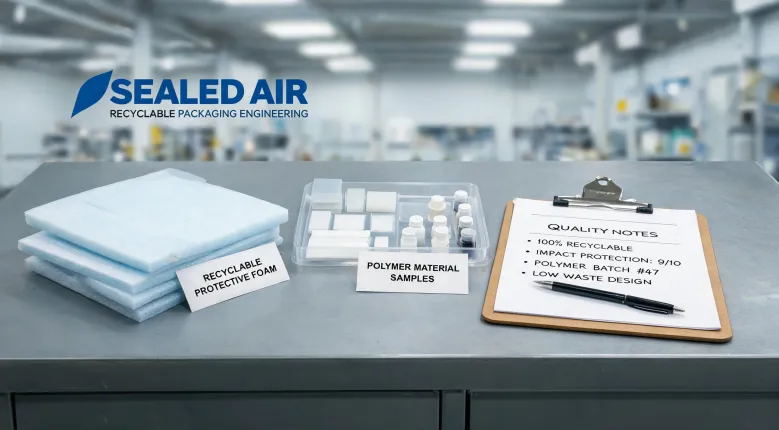
We approved the purchase order for Sealed Air recyclable packaging—Cell-Aire foam sheets in the thickness we needed, plus the $400 rush fee for guaranteed 3-day delivery. The total was about $2,800 for 8,000 sheets (including shipping). I hit 'confirm' and immediately second-guessed myself.
“Could I have negotiated down that rush fee?” I wondered. “What if Vendor A would have come through?” The two weeks until the launch were stressful—not because of Sealed Air, but because of that lingering doubt. I kept refreshing the tracking page.
Three days later, a pallet arrived. I unboxed a sample sheet. The foam sheets were uniform—no bubbles, no uneven thickness. The bonding polyethylene layers were consistent. I ran our standard compression test: 0.5% deformation at 10 psi. Exactly to spec. The quality stamp on the packing slip showed they had passed an internal inspection. That's when I felt the relief wash over me.
“So glad I pushed for Sealed Air. Almost chose Vendor A to save $400, which would have meant scrambling for last-minute alternatives—or worse, a failed launch.”
The Result: On Time, On Spec, and Recyclable
The product launch went flawlessly. Our customers received the electronics in perfect condition. The foam cushions inside the box were lightweight, protective, and embossed with a recycling code #2 (HDPE). Our marketing team used that as a talking point: “Packaging made with recyclable polyethylene foam from Sealed Air.” We even got a positive mention in a trade publication for our sustainable packaging approach.
Looking back, the $400 rush fee was the best $400 we spent that quarter. If I could redo that decision, I'd actually budget for guaranteed delivery from the start—not as a last-minute panic. At the time, I thought we could save money by rolling the dice. But given what I now know about the cost of uncertainty, I'll never go back to “estimated” delivery windows for deadline-critical projects.
The Lesson: Time Certainty Has a Price—And It's Usually Worth It
This experience cemented my belief in the time certainty premium. In my role, I review over 200 packaging orders annually. I've seen the pattern repeat: companies that pay for guaranteed delivery (whether from Sealed Air or another reliable supplier) rarely regret it. Companies that don't? They often end up paying more in rework, emergency shipping, or missed opportunities.
Sure, there are exceptions. For non-urgent, low-stakes items, standard service is fine. But when your product launch, a trade show, or a compliance deadline hangs in the balance, the cheapest quote often has hidden costs. Uncertainty is expensive.
One more thing about recyclability: If you're considering materials, know that polyethylene (PE) is one of the most widely recycled plastics. Nylon (polyamide) is not typically recyclable in curbside programs—it requires specialized facilities. That's why we chose PE foam for our packaging. Sealed Air's Cell-Aire is made from PE, and their manufacturing process is ISO 14001 certified. So you get both performance and environmental credibility.
P.S. If you're wondering about polypro foam board vs polyethylene foam: polypropylene (PP) is also recyclable, but it's stiffer and less cushioning for fragile items. We tested both. For our product, PE foam was the better match. Your mileage may vary.
About the author: I'm a quality/brand compliance manager at a consumer electronics company. I review every packaging order before it reaches customers—roughly 200 unique items annually. I've rejected 12% of first deliveries in 2024 due to spec mismatches or missed deadlines. That experience shapes every recommendation I make.

Jane Smith
I’m Jane Smith, a senior content writer with over 15 years of experience in the packaging and printing industry. I specialize in writing about the latest trends, technologies, and best practices in packaging design, sustainability, and printing techniques. My goal is to help businesses understand complex printing processes and design solutions that enhance both product packaging and brand visibility.
Leave a Reply