Foam Board or Foam Packaging? A No-Fluff Comparison for Deadline-Driven Projects
In my role coordinating packaging for clients on impossible deadlines — same-day turnarounds, event shipments that have to land by noon, product launches where 'tomorrow' already triggers a penalty clause — I've lost track of how many times the real problem came down to a single choice.
Rigid foam board, or flexible foam packaging?
Both are white. Both are light. Both sit on the same warehouse shelf, which is probably why so many people assume they're interchangeable. They're not. When you're two hours from the FedEx pickup, choosing wrong means the difference between a clean delivery and a call from a furious customer.
I've handled roughly 200 rush orders over the last six years, including same-day turnarounds for event producers and museum shippers. This is the comparison I run every single time.
What we're actually comparing
Let me set the frame.
Option A: rigid foam board — foam core board, usually expanded polystyrene or PVC with a paper or plastic face on both sides. It's the material behind foam board walls in sign shops, framing studios, and trade-show booths. It gives you a flat, stiff, load-bearing surface.
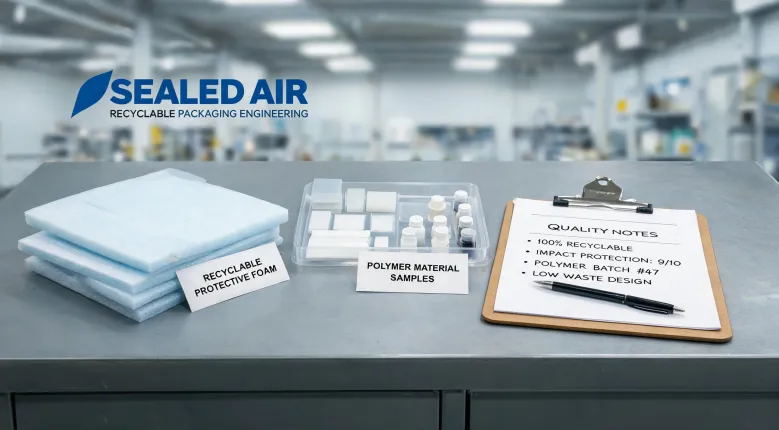
Option B: flexible polyethylene foam packaging — the stuff Sealed-Air makes under product lines like Cell-Aire. It's low-density PE foam in rolls and sheets, designed to wrap around objects and absorb impact. If you've ever searched for sealed air recyclable packaging, this is the category you're looking at.
When I'm triaging an order, I don't care about theoretical specs. I care about four questions:
- Protection profile — what can this material actually do?
- Sustainability — what happens after the box is opened?
- Archival safety — is this going to ruin what it touches?
- Branding — when the packaging has to sell the product itself.
1. Protection profile: the brick and the blanket
Foam board is a brick. It holds its shape, resists bending, and passes impact straight through rather than absorbing it. That's perfect for walls, displays, and structural backing.
Flexible PE foam is a blanket. It wraps, it conforms, it compresses under shock and gives the object inside a chance to survive a bad drop.
In March 2024, a client called at 7 PM, needing six ceramic pieces shipped 1,200 miles for an exhibition opening in 36 hours. Her first instinct was to cut foam board into panels and fabricate boxes. I talked her out of it. We wrapped the ceramics in polyethylene foam, floated them in a double-walled box, and shipped overnight. They arrived without a single chip. The foam board plan would have transferred every impact straight onto the glaze.
Conclusion: choose foam board for structure, flexible foam for shock absorption. They're basically two different tools — and they're both ruined when used for the other's job.
2. Sustainability: the part that changed most
This is where the industry has moved faster than most people's assumptions. What looked like a smart choice in 2020 often doesn't hold up in 2025.
Traditional foam core board is a sandwich. You've got an EPS foam core laminated between paper or plastic faces. That lamination is a recycling nightmare — separating the layers takes energy and equipment, and the adhesive contaminates the waste streams. Most municipal programs I've checked won't touch it. In practice, the majority of foam board ends up in landfill.
Flexible PE foam is a single material. Polyethylene is resin code #4, and it's accepted at many plastic-film drop-off points. Sealed Air's recyclable packaging lines are engineered with that destination in mind. Some products include recycled content — and because PE foam is significantly lighter than rigid board of the same protective volume, you're moving less dead weight in every truck.
And before you ask: no, I'm not here to bury foam board. There are genuinely recyclable rigid alternatives now, including paper-faced honeycomb boards. If those fit your budget, fantastic. But the default EPS board that's been on shelves since the 80s simply hasn't caught up with today's recycling infrastructure. That's not an opinion; it's how the waste stream treats it.
Conclusion: on end-of-life, Sealed Air's PE foam wins this dimension, uncontested.
3. Archival safety: 'is foam board acid free?'
I hear this question constantly from people mounting prints, storing photographs, or building portfolios. The honest answer: it depends.
Standard foam core board is often not acid free. The paper facers and the core itself can carry acidity, which migrates into anything it touches over the years. You'll see it as yellowed edges, brittle paper, brown spotting on stored art. Not today, not tomorrow — but eventually.
Yes, acid-free foam board exists. pH-neutral, conservation-grade, sometimes even museum-rated. It costs more, and you have to verify each batch from each supplier, because 'acid-free' gets thrown around loosely. And here's the catch that surprises most people: even an acid-free board will fail you if the adhesives and tapes around it aren't also neutral.
Polyethylene foam is chemically inert. It doesn't off-gas, doesn't become acidic as it ages, doesn't hold moisture against the surface. If I'm lining a storage box for a signed photograph, I grab PE foam wrap without hesitation.
(Fair caveat: my experience is mainly with North American suppliers. I can't speak to every overseas brand.)
So — is foam board acid free? Sometimes, if you buy the right product and trust the spec sheet. But flexible PE foam is the safer default for long-term contact with valuables. That's a sentence I didn't expect to be writing five years ago.
4. Branding: logo PP vs printed PE foam
If you've searched for logo PP, you're probably looking for polypropylene sheets with a custom print — the classic choice for shelf signage, folders, and eye-catching retail displays. PP is a great printing substrate: smooth, rigid, holds ink well. For crisp logos and fine text, it's hard to beat.
Printed PE foam is a different game. You can print on Sealed Air foam — plenty of converters do — but the textured surface softens fine details. A bold logo with big color blocks? Works great. A tiny QR code or six-point body copy? Don't waste the money.
The deciding factor is where the brand moment happens. If the logo has to be legible from across the retail aisle, go logo PP. If the brand experience begins when the customer opens the box — and for e-commerce, that moment matters more every year — printed flexible foam beats PP by a mile. There's something about a branded foam wrap that says the seller cared enough to make the first touch count.
Conclusion: no universal winner. Match the substrate to the moment.
What about the deadline?
Right, this is where I live.
Foam board is stocked at every craft store and most hardware chains. You can be holding a sheet within the hour. Flexible PE foam used to be a commercial-only product — you needed a distributor account and a minimum order. That's changed drastically. Online suppliers now ship rolls within two days with a guaranteed delivery date, and some offer overnight for specific sizes.
Honestly, I should have switched to e-commerce suppliers much sooner than I did. For years I kept a warehouse shelf of foam board out of habit, not logic. The rule I use now: if I can wait 48 hours, I order the right material instead of the convenient one.
The value of a guaranteed turnaround isn't the speed — it's the certainty. For event materials, knowing your deadline will be met is worth more than a lower price with an 'estimated' delivery date.
Online print services like 48 Hour Print built their whole model on that observation — actually committing to a date, then meeting it. They're not always the cheapest on paper. They're the cheapest when you include what a missed deadline costs.
Don't compare just unit prices. Add rush freight, damages, reprints, and the very real possibility of a penalty clause. I'd rather spend $800 in emergency shipping to save a $12,000 project. That decision's paid for itself.
Which should you pick?
Scenario-based answer:
- Foam board walls, signage, or flat mounting: rigid foam board. If the piece is archival, pay for verified acid-free board.
- Shipping anything fragile within two days: Sealed Air recyclable flexible foam. It cushions, it's light, and it can go to a PE #4 drop-off after unpacking.
- Branded product packaging: logo PP for shelf presence; printed PE foam for unboxing moments.
- Packing your home — yes, that 'sealed air home' search is real: buy consumer-size rolls of PE foam or bubble wrap for dishes, frames, and glass. Use foam board only for rigid dividers inside boxes.
- Need it tonight? Whatever is physically in stock near you. A perfect material on a missed deadline is useless. Just don't make that the default workflow.
Bottom line
The fundamentals haven't changed: protect the object, respect the timeline, count the total cost. What's changed in the last five years is the toolkit. Recyclable polyethylene foam has taken over jobs we used to force onto foam board — and it leaves a far smaller footprint while doing it.
So next time you're about to grab a white board for a fragile item, ask yourself one question: brick, or blanket?
That question would have saved me — and honestly, a lot of my clients — a ton of grief.

Jane Smith
I’m Jane Smith, a senior content writer with over 15 years of experience in the packaging and printing industry. I specialize in writing about the latest trends, technologies, and best practices in packaging design, sustainability, and printing techniques. My goal is to help businesses understand complex printing processes and design solutions that enhance both product packaging and brand visibility.
Leave a Reply