Sealed Air Products vs. Decorative Foam Board: A Quality Inspector’s Comparison
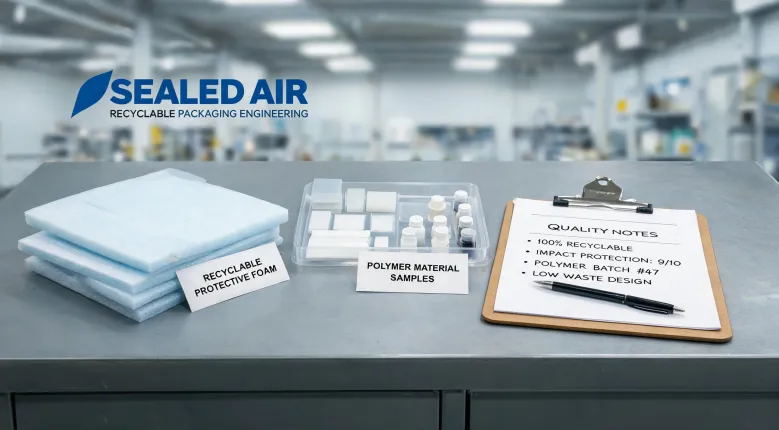
I get this question more than you'd expect: "Doesn't Sealed Air make plastic explosives?" It doesn't. Sealed Air makes protective packaging — polyethylene foam, air cellular cushioning, and other materials. The "plastic" in plastic explosives isn't the same as the "plastic" in polyethylene. One is a polymer; the other is a moldable explosive binder. Different universe.
But if you're here, you're probably not asking about explosives. You're trying to decide between Sealed Air products and something cheaper. As a quality and brand compliance manager at a packaging manufacturer, I've spent the last four years reviewing 200+ unique materials a year. In 2024, I rejected 11% of first deliveries because the specs didn't match. This article is based on what I actually check.
The Comparison Framework
Two categories show up in my receiving queue a lot. Category A is engineered protective packaging sold under the Sealed Air name — Cell-Aire polyethylene foam, air cellular cushioning, recyclable films. Category B is commodity material: decorative foam board, unbranded plastic sheeting, and rolls of "same thing." The standard I use for both is simple. Does the material do what the sales page promised? Can I verify it? And what happens when it fails on the line or in the field?
Material Consistency: Engineered Foam vs. Decorative Foam Board
From the outside, decorative foam board looks like a stiff, cost-saving version of protective foam. The reality is it's a different product. Decorative foam board has a rigid core with paper facers, made for signs, displays, and craft projects. It doesn't bend, which makes it look stronger than flexible foam. That stiffness is exactly the problem when you're wrapping something fragile.
Sealed Air's Cell-Aire polyethylene foam is closed-cell and flexible. It compresses under impact, absorbs energy, and then recovers. A decorative foam board can crack or transfer shock on the second or third drop. If you need proof, run a simple drop test with a 10-pound box. The flexible foam wins every time. (For context: USPS Business Mail 101 caps a standard letter at 0.25 inches thick. A foam board display sign usually blows past that. It's a display material, not a shipping material.)
Conclusion: Not all foam is equal. Period. If your application is protective packaging, engineered polyethylene foam is the relevant material. Decorative foam board is for crafts.
The Logo Question: What "Logo Sealed Air" Actually Tells You
Why does the logo matter? Because a genuine Sealed Air logo is a traceability mark, not a decoration. It ties that roll to a lot number, a material data sheet, and manufacturing records. When a listing says "logo sealed air" but the photo shows a blurry red mark and no lot details, that's a red flag.
In 2022, I implemented a verification protocol that starts with the logo and ends with the certificate of analysis. Our wrong-material deliveries dropped by about a third. A brand mark is a shortcut to documentation. Without it, you're trusting a label that says "equivalent." Sometimes it is. Sometimes it isn't. I don't accept "trust me" on a purchase order.
Conclusion: Treat a missing logo as unverified. If the seller can't provide the lot number and the data sheet, that's your answer.
Recyclability: Is Polyethylene Sheeting Recyclable?
Is polyethylene sheeting recyclable? Yes — kinda. Clean polyethylene film is generally recyclable as LDPE, resin code 4. The catch is access. Many curbside programs don't accept film. You often need a drop-off at a store or transfer station.
The catch is access
Per FTC Green Guides, environmental claims like "recyclable" must be substantiated. A product claimed as recyclable should be recyclable in areas where at least 60% of consumers have access. That's why you'll see "check locally" in fine print. It's not a dodge; it's a legal necessity.
What does this mean for Sealed Air products? The company publishes material data and recyclability documentation. If you're a buyer, ask for it. If you're evaluating a generic product, ask for the same. The fact that it looks like polyethylene doesn't mean it's the same resin. And "recyclable" isn't a synonym for "accepted in my bin."
Conclusion: Polyethylene sheeting is recyclable, but the responsible answer is "it depends." Resin, local access, and documentation all matter. One-word answers are usually wrong.
The Real Cost: When "Cheaper" Costs $18,000
Now the part that got my attention in Q1 2024. We received 2,000 pieces of "equivalent" polyethylene sheeting. The thickness was off by 15% against our 2-mil spec. Normal tolerance is ±5%. The vendor said it was "within industry standard." (Surprise, surprise.) I rejected the batch. They redid it at their cost, but the line delay was on us. That discrepancy cost about $18,000 in rework and missed production time.
The vendor failure in March 2023 changed how I think about material specs. One critical deadline missed, and suddenly the $0.03 per-foot savings wasn't a savings at all. After that rejection, I kept second-guessing myself: was I too strict? What if the replacement batch held the same problem? I didn't relax until the new lot came with a lab report that matched the spec. It did.
Five minutes of verification beats five days of correction.
That's not a poster quote. It's a receiving procedure. The question isn't "Is Sealed Air more expensive?" It's "What does a failure cost?" If the product is going into a branded commercial shipment, a field failure is huge. If it's a prototype in the office, maybe cheap. Know the risk before you choose.
Which One Should You Choose?
Here's where the comparison lands. It depends on the job.
- Fragile product, high risk, field failures unacceptable: Use engineered protective packaging with documented specs. Sealed Air products are a good match, but the name isn't the reason. The documentation is.
- Sign, display, craft board, or temporary backing: Decorative foam board is fine. Don't pay engineered foam prices for a job that doesn't need impact data.
- Need to answer "is polyethylene sheeting recyclable?" for your own label: Start with the resin code, check local access, then get the substantiation in writing. Don't guess.
After four years of rejecting shipments, I've learned that the expensive version isn't always better, and the cheap version is never cheaper if it doesn't do the job. The thing that saves you is the thing you can't see until you look: spec compliance, traceability, and a material made for the application. That's the standard. Use it.

Jane Smith
I’m Jane Smith, a senior content writer with over 15 years of experience in the packaging and printing industry. I specialize in writing about the latest trends, technologies, and best practices in packaging design, sustainability, and printing techniques. My goal is to help businesses understand complex printing processes and design solutions that enhance both product packaging and brand visibility.
Leave a Reply