The Cheap Packaging Trap: What 6 Years and $180K in Procurement Data Taught Me
In early 2023, I got a quote that looked like a no-brainer. A vendor offered us polyethylene envelopes at 38% below our current price. Same sizes, same flap style, similar lead times. According to their sales rep, “it’s the same product.”
I almost went with them.
Then I ran a sample test. Twenty-five envelopes, a standard 2-pound catalog, and a 30-inch drop. Nine of the 25 split at the seam. So glad I tested first.
“You’re testing beyond the intended use case.”
Right. Because the intended use case of an envelope is to look nice on a shelf.
I’ve been a procurement manager at a regional print and fulfillment company for six years. We’re about 40 people, and I manage a roughly $180,000 annual budget for packaging materials and shipping supplies. I’ve negotiated with 40+ vendors, documented every order in our cost tracking system, and learned the hard way that the cheapest option is rarely the most cost-effective one.
The Problem Everyone Starts With: “Packaging Costs Too Much”
Every budget cycle, the conversation is the same. Packaging is a cost center. It doesn’t generate revenue. So let’s squeeze it.
And there are real savings to find. In our 2022 audit, I found we were overpaying by about $8,400 a year for foam board because a legacy vendor had quietly raised prices and we hadn’t renegotiated. We switched, and the savings showed up in the P&L immediately. That’s the good kind of cost-cutting.
But there’s another kind.
The kind where you trade a visible savings today for a hidden cost tomorrow. It’s harder to spot because the cost shows up on a different line: customer refunds, replacement orders, staff hours spent handling complaints. And by then, the person who made the “smart” purchasing decision has moved on to the next budget item.
The Real Problem: You’re Comparing Price, Not Specifications
Here’s the thing about packaging materials: they all look the same in a quote. A polyethylene envelope is a polyethylene envelope. A foam sheet is a foam sheet. A bubble mailer is a bubble mailer.
But they’re not the same at all.
The cheap envelopes I tested were 1.5 mil thick. Our spec was 3.5 mil. The manufacturer saved resin by using a thinner film, which made the envelope look identical but fail exactly where you’d predict — at the seam, under load. Nobody would knowingly buy a 57% thinner envelope. But that’s what happens when you compare prices before you compare specs.
I see the same problem in almost every material category.
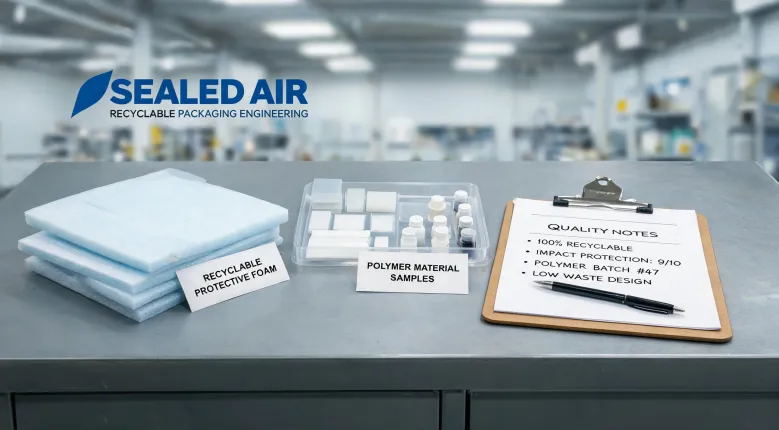
Foam board posters are a perfect example. We print and ship large-format posters for trade shows and retail displays. The cheap foam boards are made from low-density material that bends, warps, and arrives with dented corners. The better ones — like Sealed Air’s Cell-Aire polyethylene foam line — use closed-cell construction that keeps its shape through the worst that a parcel carrier can throw at it.
Same “foam board.” Completely different product.
The lesson goes beyond packaging. Last year I reviewed quotes for a concrete repair project in our facility. Our loading dock area had settled and was creating a trip hazard. Our facilities lead put two options in front of me: mudjacking and polyurethane foam injection.
The mudjacking quote was about 30% lower. But here’s what the price tag didn’t show: mudjacking uses a heavy cement slurry that takes days to cure. Polyurethane foam cures in about 15 minutes and is much lighter, so there’s less risk of settling again. For a loading dock we rely on every single day, a 30% discount would have cost us days of downtime — and quite possibly a redo.
Comparing polyurethane foam vs mudjacking by price alone is exactly like comparing envelopes without checking mil thickness. The cheaper option isn’t a better deal. It’s a different product that happens to share a name.
So the real problem isn’t that packaging materials cost too much. It’s that we compare price tags when we should be comparing performance.
The Cost of Corners Cut: Damage, Refunds, and Lost Clients
Let me put some numbers on this.
We ship about 4,000 packages a month. When we tested budget poly mailers against proper air-cushioned mailers, the budget ones had a 2.1% damage rate. The air-cushioned mailers — the kind with real sealed-air chambers in the lining — had a 0.9% damage rate.
That 1.2-point difference doesn’t sound dramatic. But over a year, it’s 576 additional damaged packages. At an average cost of $30 to make a damaged shipment right (replacement product, repackaging, reshipping), that’s $17,280.
The budget mailers saved us about $1,900 a year in unit cost.
So we’d be spending $1,900 a year to create $17,280 in damage claims. That’s not cost control. That’s setting money on fire.
Large-format products are even worse. When we shipped foam board posters without rigid backing, our damage rate was 8% — about one in twelve arrived bent, creased, or cracked. Adding a stiff foam board insert cost us $0.80 per package and dropped the damage rate to under 1%.
We ship about 200 posters a month. The inserts cost us roughly $1,920 a year. They eliminate about $4,200 in damage and reprint costs. That’s a net win of $2,280 — before counting the customer service hours we no longer burn on “your poster arrived folded” emails.
$0.80 per package isn’t a premium packaging upcharge. It’s insurance with a positive return.
And none of this counts the damage to client relationships. In Q2 2024, a client who’d been with us for three years placed an urgent order for their annual conference. Someone in our shipping department — trying to be helpful — used a budget envelope that wasn’t spec’d for the weight. The envelope tore in transit, the materials were ruined, and we had to reprint and expedite everything. The redo cost us about $1,400.
We absorbed it, obviously. The alternative was losing the account.
Looking back, I should have caught the spec issue earlier. The shipping team didn’t know about mil thickness — why would they? But our procurement system should have flagged the substitution. Now it does.
If there’s one thing I’d tell my younger self: pay for the shipping materials that don’t fail.
What Changed My Approach (and What I’d Do Differently)
After the envelope incident, I rebuilt our purchasing process. It’s not complicated, but it works.
- Write down the spec before you ask for a price. We document mil thickness, burst strength, cushioning requirements, and board rigidity. If a vendor can’t match the spec, they’re not invited to bid.
- Test samples before you sign anything. We spend about $400 a year on sample testing. It’s the cheapest due diligence we do.
- Track damage rates by product category. Our quarterly review isn’t just about what we paid. It’s about what we paid relative to what went wrong.
- Build relationships with vendors who can actually deliver. The vendors who know our specs and our deadlines will move heaven and earth when we need help.
That last point connects to something I’ve learned about the value of certainty.
In March 2024, a client needed 2,000 large-format posters at their trade show booth in four days. Standard production would have taken six. We paid a rush printing premium — about 35% above standard pricing, roughly $700 on that order. For context, 2-3 business day rush service typically runs 25-50% higher, and next business day runs 50-100% higher (based on major online printer fee structures, January 2025; verify current rates). Plus expedited shipping.
The client’s trade show generated an estimated $15,000 in new business leads. If we’d missed the deadline, we’d have lost the client.
So, was $700 the right call? Yes. I’d make it again.
An expedite fee often looks like a penalty. But it’s really the price of certainty. When a deadline matters, “probably on time” is the riskiest option in the room. An uncertain delivery estimate isn’t a discount. It’s a bet. And when the bet is against your own client relationship, the house always wins.
You don’t need premium pricing on every order. But when a delivery matters — to a client, to an event, to a product launch — paying for certainty is the cost-effective choice.
The Bottom Line
Cutting packaging costs is legitimate. Waste is real, and we found real savings. But the goal isn’t to buy the cheapest polyethylene envelope or the cheapest foam board. The goal is to minimize the total cost of getting a product to a customer intact — including damage, reprints, refunds, and lost credibility.
Protection is not a luxury. It’s the product experience.
Whether you’re a procurement manager or someone buying sealed air products for home packing, the math is the same: the thing you’re protecting is worth more than the packaging. Every time I’m tempted by a “too good to be true” quote, I remember those nine torn envelopes.
And I ask one question: what’s it worth if it doesn’t arrive?

Jane Smith
I’m Jane Smith, a senior content writer with over 15 years of experience in the packaging and printing industry. I specialize in writing about the latest trends, technologies, and best practices in packaging design, sustainability, and printing techniques. My goal is to help businesses understand complex printing processes and design solutions that enhance both product packaging and brand visibility.
Leave a Reply