Sealed Air Foam Sheets: The Cost Hidden in the Spec Nobody Reads
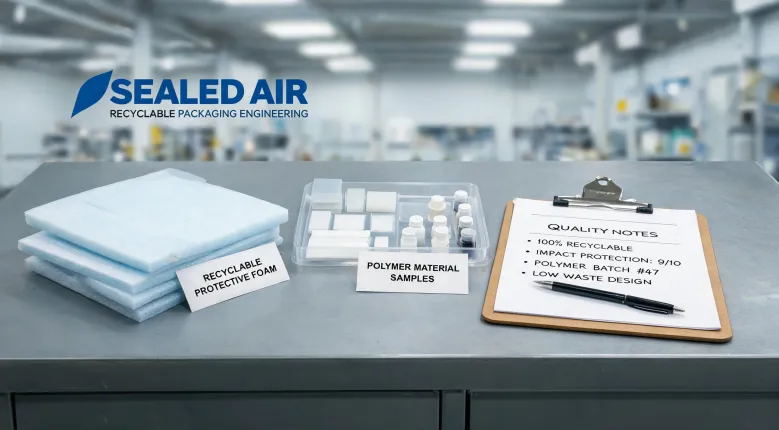
For six years, I've tracked every packaging invoice that crossed our procurement system. Between 2020 and 2024, our protective packaging spend totaled roughly $180,000 — split across foam sheets, custom die-cuts, and the occasional rush-order panic buy. If there's one thing that taught me, it's this: the cheapest quote for "sealed air foam sheets" is rarely the cheapest by the time your boxes land on a customer's doorstep.
On the surface, buying foam is simple. Pick a thickness. Pick a size. Compare price per sheet. Done. So what could possibly go wrong?
Turns out, a lot. Not in the foam itself. In the specification hiding in the listing.
Search "sealed air foam sheets" on any marketplace and you'll see the same photos repeating. Same color. Same dimensions. Similar prices. Then, in fine print — density. Or worse, no density at all. If you don't know what that number means, you're not comparing prices for the same product. You're comparing prices for two different products that happen to share a name.
So let's answer the question hiding behind all of it: what are polyethylene plastics, and why does that answer determine your packaging budget?
What are polyethylene plastics, anyway?
Polyethylene is the most common plastic on the planet. Simple to describe: ethylene gas gets polymerized into long chains. Depending on how those chains form, you get different plastics — HDPE for bottles and jugs, LDPE for film and bags, and, in our world, polyethylene foam.
Foam is a solid plastic with gas trapped inside. The gas gives it cushioning, but the plastic matrix does the real work. Two sheets of polyethylene foam can look identical and perform entirely differently, based on what's happening inside that matrix.
This is the part buyers miss. Honestly, I missed it for years. "Polyethylene foam" sounded like one thing to me. It's a family, not a material. Within that family, you choose between different densities, cell structures, and processes — some foams are cross-linked, some are not; some recover from compression, some take a set and never come back.
Cell structure matters too, though you can't see it without a magnifier. Open-cell foam lets air move through it — softer, but slow to recover from heavy impact. Closed-cell foam traps gas in sealed pockets — firmer, more resilient, better for protecting heavy parts over long transits. Polyethylene foam used in packaging is almost always closed-cell, but that still leaves suppliers room to dial performance up or down in ways the naked eye can't catch.
The suppliers who know what they're doing talk about these numbers up front. The lazy ones quote a color and a price. Guess which one looks cheaper.
The spec that changes everything: density
Density is how much plastic is packed into each cubic foot of foam. It determines how much load the foam handles, how it absorbs impact, and how it behaves after being crushed inside a trailer for 600 miles. Low-density foam is a cushion. Higher-density foam is a structural block.
Here's my $800 story.
Everyone told me to check density before ordering. I'd nod, then keep buying the cheapest sheets. One year, we had a heavy product launch — cast-iron cookware, if you're curious — and the team started packing two weeks early. The cut sheets sat in the warehouse, stacked under other inventory. By launch day, the foam was compressed. Permanently. It had taken a set. It wasn't cushioning anything.
I only believed that advice after ignoring it. The batch produced a 12% damage rate. Returns, re-packing, a rushed replacement order — roughly $1,200 burned on a $3,800 order. Not a percentage. A hemorrhage.
Looking back, I should have run a simple compression test on samples upfront. At the time, it felt like overthinking a piece of foam. Now it feels like the bare minimum for spending other people's money.
The shapes nobody prices correctly
This one's for the buyers ordering shapes, not flat sheets.
Circle foam board and polyethylene cylinder parts are not "fancier squares." When you die-cut a circle from a sheet, the material around it becomes scrap — and that scrap is priced into the part. So when a supplier quotes a circle foam board lower than the equivalent flat sheet, it's worth asking how. Usually the answer is a softer, thinner, or off-spec grade.
Polyethylene cylinders are even trickier. They protect edges and corners, and they can be molded, extruded, or cut from a billet. Each method carries a different cost structure and a different strength. One supplier's quote might look 30% higher because they're using a denser material that actually protects the product. The other quote looks cheap because it is, in every way that matters at 2 a.m. when a customer calls about a crushed corner.
And don't get me started on "free setup" for die-cutting. A converter once promised free tooling on a circle foam board order, then recovered the cost in a per-piece tariff 30% over the market rate. We paid for that setup — just in pieces, over months, like a faucet drip. It's in our cost tracking spreadsheet, and it's the reason our quote sheet now requires every charge itemized before we sign.
What the cheap quote costs you in practice
In Q2 2024, I almost switched all of this to a new vendor. The established converter was reliable but priced at a premium. A newcomer offered equivalent-looking foam sheets at 18% below. On paper, it was the obvious move.
Then I pulled up the cost tracking sheet and checked the other columns. The new supplier's free shipping kicked in at four times our usual order volume, which meant overstocking or paying freight. Their lead time was 2 weeks against the 5 days we were used to, which meant idle downtime on our packing line. And there was no engineering support — no density recommendation, no sample, no "here's what we'd use for cast-iron cookware." Just a price.
I went back and forth for two weeks. The per-unit savings were real. But accepting them meant trading freight, downtime, or spec risk. We stayed with the established vendor.
Honestly, I'm still not sure why that newcomer's model doesn't work for buyers like us. My best guess: their overhead only makes sense at massive volume, so the price is a teaser that falls apart once you ask for anything real.
Which brings me to the part I care about most: small orders. When we started with our current supplier, we were the $400 order nobody expects to hear from again. They answered questions, sent samples, helped choose the grade. Seven years later, that account is $20,000+ a year. Vendors who take small buyers seriously capture the upside that dismissive suppliers don't see.
The short version: what I'd do today
If you're buying foam and packaging materials, the full analysis is worth doing once. If you only have 15 minutes right now, this is the short version:
- Ask for two numbers. Density and compression recovery. Put them in writing. If the vendor can't, that's your answer.
- Crush a sample. Put a heavy object on the foam for 24 hours, remove it, see if it bounces back. This test has told us more than any datasheet — and if you want the formal version, physical property testing for polyolefin foams follows industry standards like ASTM D3575.
- Price per shipped unit, not per sheet. Divide total packaging cost by the number of units that arrive undamaged. That's the only metric that matters.
- Check compliance once, carefully. For EU-bound goods, confirm the foam meets relevant chemical requirements and can document RoHS/REACH where needed. It's the baseline, not a nice-to-have.
- Use the sustainability report. The Sealed Air sustainability report is public — I pulled the latest edition in January 2025 to verify a recyclability claim before changing our packaging spec. Even if you're not a Sealed Air customer, it's one of the more readable industry documents on what polyethylene foam can and can't do in circular packaging programs.
Density is not a premium add-on. It's a performance requirement. Pay for it in the quote, or pay for it in the field.
So next time a price on sealed air foam sheets looks too good to pass up, ask why. The answer will tell you exactly what you're buying.

Jane Smith
I’m Jane Smith, a senior content writer with over 15 years of experience in the packaging and printing industry. I specialize in writing about the latest trends, technologies, and best practices in packaging design, sustainability, and printing techniques. My goal is to help businesses understand complex printing processes and design solutions that enhance both product packaging and brand visibility.
Leave a Reply