The Day Cheap Foam Cost Us $2,400: A Purchasing Manager's Take on Sealed Air Foam Sheets
It started with a $2,400 broken part
Last April, I was standing in our warehouse staring at a broken control unit. The cardboard box looked fine — no dents, no crush marks. But inside, the foam cushioning had flattened like a pancake. The part had shifted during transit and hit the side of the box. $2,400 down the drain.
That order had my name on it. Well, technically the purchase order had my signature. And when I say I felt a knot in my stomach, I'm not exaggerating. I'm the office administrator for a 200-person company. I manage all our packaging supplies ordering — roughly $85,000 annually across eight vendors. I report to both operations and finance. So every damaged shipment is not just an inconvenience; it's a stain on my record.
This particular order was part of our 2024 vendor consolidation project. We were trying to cut costs by reducing our supplier list from eight to four. The foam board we'd been using was cheap — about 30% less than the previous material. It seemed like a win. But I was about to learn about the difference between price and cost.
Why everyone was talking about foam board vs coroplast
Here's the thing: when I started researching protective packaging, I kept seeing comparisons of foam board vs coroplast. Those are display materials, not shipping cushioning. Coroplast is a hollow plastic sheet used for signs. Foam board is a rigid board with a foam core — also for signs. Neither is designed to absorb shock during transit.
But we had been using foam board as a cheap stand-in for real cushioning. It looked protective. It was light. It was easy to cut. And it failed.
People assume the lowest quote means the vendor is more efficient. What they don't see is which costs are being hidden or deferred. In our case, the hidden cost showed up as a damaged control unit.
Not ideal, but workable? No. Not workable at all.
The frustration of finding a supplier who could back up their claims
After the incident, I went back to the vendor. I asked for material specifications — density, compression set, static load rating. They sent me a generic sales sheet with no numbers. I asked for test data. They said they don't do testing. I asked about recyclability. They said it was recyclable. But per FTC guidelines (ftc.gov), a product claimed as recyclable should be recyclable in areas where at least 60% of consumers have access. We checked with our local recycler. They don't accept foam board because the paper facings contaminate the foam. So that claim didn't hold up under FTC 16 CFR Part 260 (Green Guides).
The most frustrating part of vendor management: the same issues recurring despite clear communication. You'd think written specs would prevent misunderstandings, but interpretation varies wildly.
How we ended up with sealed air foam sheets and PE foam pads
Then I called a distributor I had worked with before. They suggested we look at Sealed Air products. I'll admit, I was skeptical. Sealed Air is associated with bubble wrap and mailers. But they also make industrial-grade protective packaging — sealed-air foam sheets and PE foam pads made from polyethylene foam, using their Cell-Aire technology.
I requested samples. And this is where things got interesting.
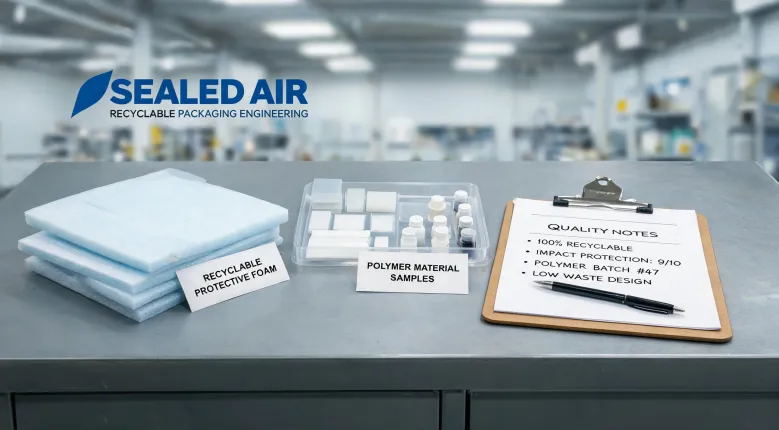
The samples arrived with actual documentation. Not a sticky note — a spec sheet. Density, thickness, compression deflection at 25% and 50%, water absorption, thermal insulation values. They also included recyclability documentation showing the foam can be recycled where facilities exist.
We ran a simple drop test. We took two identical boxes, one with the old foam board and one with a sealed air PE foam pad. We dropped them from waist height onto a concrete floor. The foam board cracked. The PE foam pad absorbed the impact and bounced back. Not a scratch on the test part.
Now, I'm not saying every product needs to meet military drop spec. But it was enough to convince me — and our operations manager — that the extra cost was worth it.
One more factor: USPS shipping requirements. According to USPS (usps.com), as of January 2025, a large envelope must be between 6.125 x 11.5 inches and 12 x 15 inches, with thickness up to 0.75 inches. Our sealed air foam sheets come in various thicknesses — 1/8 inch, 1/4 inch, 1/2 inch, 3/4 inch. We could choose an option that protected the part without pushing us into a bigger parcel classification. That's a real cost saving that doesn't show up on the unit price.
We also looked at sheet rubber for one application. Sheet rubber is durable and resistant to punctures, but it's heavy and expensive for our use case. The PE foam pad offered similar cushioning at a fraction of the weight. Not ideal for every situation, but right for ours.
What I wish someone had told me sooner
Looking back, I should have asked better questions earlier. Here's what I'd tell any purchasing peer:
First, know your product's fragility. Don't assume you can use foam board vs coroplast for shipping. Those are for signage. Ask about the material's shock absorption and recovery.
Second, get specifications in writing. Density and compression values are not nice-to-have; they're essential. If a vendor can't provide them, that's a red flag.
Third, verify environmental claims. If a vendor says a product is recyclable, ask where it's recyclable. Check against FTC guidelines. It's not just about being green; it's about avoiding false claims.
Finally, think about total cost. The lowest-priced material isn't the cheapest if it costs you a $2,400 replacement part and a customer who loses trust.
Personally, I think that final point is the one that matters most. Since we switched to Sealed Air products, our damage rate has dropped significantly. I can't give you exact percentages without pulling the numbers, but it's been a clear difference.
So, would I recommend Sealed Air to another administrator? Yes. But not because they're the only option. They're the option that gave us the documentation we needed and the performance we tested. That's the standard I expect now.
We still use foam board and coroplast — but for signs, not shipping. And I sleep a little better knowing our next control unit will arrive in one piece.

Jane Smith
I’m Jane Smith, a senior content writer with over 15 years of experience in the packaging and printing industry. I specialize in writing about the latest trends, technologies, and best practices in packaging design, sustainability, and printing techniques. My goal is to help businesses understand complex printing processes and design solutions that enhance both product packaging and brand visibility.
Leave a Reply