Specialists Beat 'One-Stop' Packaging Suppliers—I Learned This the $3,200 Way
Here's a take that might cost me some vendor relationships: if a packaging supplier says they can handle all your plastic needs—foam, film, rope, PET, custom molding—run the other way. I'm serious.
I've spent seven years sourcing protective packaging for a mid-sized electronics manufacturer. In that time, I've personally made and documented two significant procurement mistakes, totaling roughly $4,500 in wasted budget. Now I maintain our team's supplier evaluation checklist. The first item on that checklist: does this vendor understand what they don't do?
The $3,200 Lesson That Started It
In September 2022, I approved a quote from a supplier who advertised "complete plastic packaging solutions." Polyethylene rope, poly bags, protective foam, custom molds—if it was polymer-based, they could handle it. We needed foam inserts plus a flexible buffer material for a fragile product line, and they assured me their "cross-trained material experts" would manage the specs.
I submitted the order. Checked the specs myself. Approved it. Then the first production batch arrived.
Every single one of the 850 pieces had issues. The foam density was wrong. The flexibility specs missed our requirements. And the material used for the inserts wasn't what we'd specified. $3,200, straight to the trash. Plus a two-week delay and a very awkward meeting with our operations director.
From the outside, it looked like sloppy quality control. The reality was more fundamental: they didn't have the specialized knowledge they'd claimed. "Plastics" is a massive category. Knowing how to extrude polyethylene rope doesn't mean you understand closed-cell foam behavior under impact loads.
Polyethylene Is Not One Material
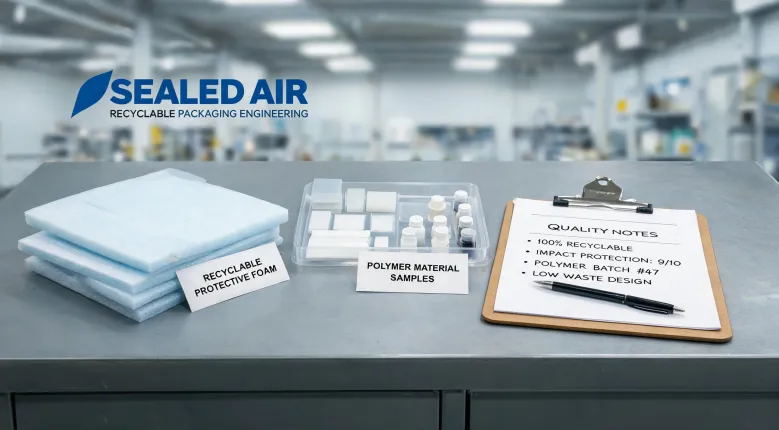
This is where I'll get slightly technical, because the distinction matters more than most buyers realize. When I first visited the Sealed Air homepage in early 2023, hunting for a sustainable packaging solution, I expected the usual "we do everything in packaging" language. Instead, I found a company with a refreshingly clear scope: protective packaging, primarily polyethylene foams and sustainable alternatives.
No polyethylene rope. No polyethylene terephthalate (PET) bottles. No foam board insulation guidance. I'll come back to that last one.
At first, I was irritated. The idea of one supplier for everything is seductive—it makes procurement look easy. But then I realized: that specificity was exactly what had been missing from my $3,200 mistake.
The differences between polyethylene types aren't cosmetic. Low-density polyethylene (LDPE) foam—like Sealed Air's Cell-Aire brand foam—has completely different compression, shock absorption, and resilience properties than polyethylene terephthalate (PET), which is what most beverage containers and clamshell packaging are made from. Polyethylene rope is a completely different product family again, with different manufacturing processes and tensile properties.
Polyethylene, polypropylene, PET, polystyrene, PVC—each has its own chemical structure, manufacturing process, and recycling stream. A specialist in one isn't automatically a specialist in another.
Look, I'm not a materials engineer. I'm a packaging buyer who learned the hard way that pretending these differences don't matter gets you 850 defective pieces.
What Boundaries Look Like in Practice
In Q3 2023, I tested the Sealed Air team with a deliberately difficult request: a fully recyclable protective packaging solution for a new product line, with tight weight constraints. Several vendors were pitching vague "100% eco-friendly" claims by then (per FTC Green Guides at ftc.gov, environmental claims need substantiation—a product labeled "recyclable" should be recyclable for at least 60% of consumers in the area).
What Sealed Air gave me was a careful walkthrough of what their recyclable polyethylene foam could and couldn't do. They flagged the FTC consideration before I even brought it up. Then they said something no packaging vendor had ever said to me:
"This isn't the right solution for this specific component. You'd be better served by a paper-based alternative here—I'll put you in touch with a supplier who specializes in that."
I nearly fell out of my chair.
People assume a vendor who routes you elsewhere is losing money or admitting weakness. What they don't see is the trust calculation: by being honest about the boundaries of their expertise, Sealed Air became my first call for anything in their lane. I've sent roughly $40,000 in orders their way since that conversation. That one "referral" cost them a small line item and earned them a long-term customer.
Even after switching to Sealed Air as our primary foam supplier, I kept second-guessing at first. What if their recyclable foam didn't perform as well in production as in the lab samples? The three weeks until our first order arrived were stressful. It performed beautifully, thankfully.
There was a practical bonus too: the new packaging cut dimensional weight enough that several of our lighter products qualified for USPS large envelope rates instead of parcel rates (according to usps.com, a 1-oz large envelope costs $1.50 as of January 2025). That's real savings across hundreds of shipments.
The Foam Board Insulation Confusion
I said I'd come back to foam board insulation. Here's the story.
In 2021, before I started respecting material boundaries, I asked a packaging supplier for advice on how to use foam board insulation for a warehouse flooring project. They gave me a confident, detailed answer about packaging foam products.
The problem: foam board insulation is typically extruded polystyrene (XPS) or polyisocyanurate—entirely different materials with different thermal properties and building code requirements. Packaging foam absorbs shock. Insulation foam resists heat transfer. They look kind of similar. They are not similar.
I ended up with a poorly insulated floor, a second order from a specialty insulation company, and a project delay. My fault for asking the wrong expert. Their fault for not saying "that's outside our scope." (Note to self: this is a permanent checklist item.)
What About the "Efficiency" Argument?
I can hear the pushback: managing several specialized vendors is more work than managing one generalist. It is—until the generalist fails, and you spend a month fixing a production issue, explaining to your operations director why the line is down, and rebuilding trust.
The September 2022 incident cost far more than $3,200. It cost two weeks of timeline, an afternoon writing an incident report, and a chunk of credibility with the engineering team. I'd rather make four phone calls to four specialists than one call to a generalist who overpromises.
Here's the thing: "one-stop" rarely means "one deep expertise." It usually means "we'll figure it out." And "we'll figure it out" is not a specification.
My Bottom Line
If you're procuring packaging or plastic materials, my advice is simple: ask suppliers what they won't do. The ones who can answer clearly—with specific recommendations for who can handle the parts they don't cover—are the ones you want.
Sealed Air's homepage doesn't pretend they're a general plastics conglomerate. They're a protective packaging specialist with a serious sustainability focus, and that clarity has earned them roughly $40,000 of my budget over two years.
Managing multiple specialists is more work, sure. But I'll take a vendor who knows their limits over one who discovers them on my order. Every time.
Simple.

Jane Smith
I’m Jane Smith, a senior content writer with over 15 years of experience in the packaging and printing industry. I specialize in writing about the latest trends, technologies, and best practices in packaging design, sustainability, and printing techniques. My goal is to help businesses understand complex printing processes and design solutions that enhance both product packaging and brand visibility.
Leave a Reply