The 48-Hour Packaging Rescue That Rewrote My Compliance Checklist
It was 4:30 on a Friday afternoon when the call came in. A medical device client I'd worked with for years had a packaging emergency. Their product launch was Monday morning, the custom protective packaging they'd ordered from another supplier hadn't arrived, and the compliance paperwork was missing entirely.
"We need something RoHS compliant, REACH compliant, and something our sustainability team won't fight us on," the procurement manager said. "Oh, and we need it by Monday."
Normal lead time for custom protective packaging is five to seven business days. We had about 64 hours, including a weekend.
How the original order fell apart
Here's what went wrong with their first vendor. The client went with a supplier who quoted about 30% below market rate. Looked great on paper.
But when the compliance documentation was supposed to arrive? Crickets. The supplier kept saying "it's all compliant, don't worry" — but couldn't produce a single test report. No RoHS declaration. No REACH substance data. Nothing in writing.
I've learned to ask "what's NOT included" before "what's the price." The vendor who lists everything upfront — even if the total looks higher — usually costs less in the end.
Matching the right material to the job
The product was a compact diagnostic device — about the size of a paperback, heavier than it looked. It needed shock protection, electrostatic discharge safety, and packaging that wouldn't raise red flags with the client's own regulators.
We had a few material options, and this is where the real decision-making happened:
- Polypropylene plastic sheet — rigid and recyclable, but not great at absorbing impact on its own. Usually needs to pair with a cushioning layer.
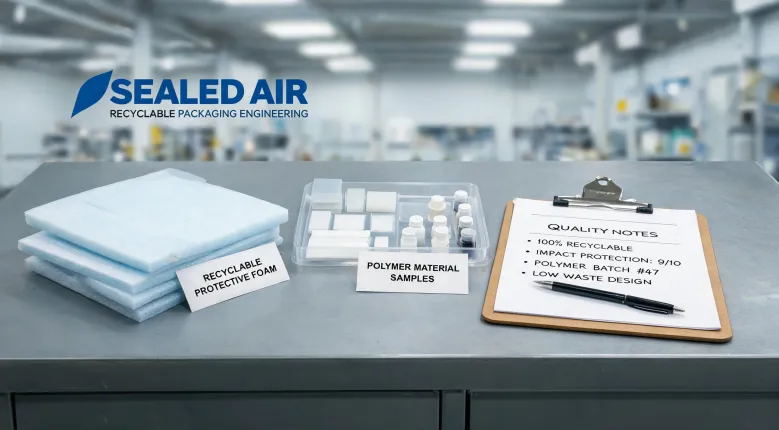
- Laminated foam board — Sealed Air's Cell-Aire polyethylene foam bonded to a polypropylene sheet. Lightweight, excellent shock absorption, and available in recyclable configurations.
- Standard expanded polystyrene (EPS) — cheap, but harder to recycle in many municipal streams. Many of our clients have moved away from it altogether.
When people hear "polyethylene foam," they picture the squishy sheets inside consumer electronics boxes. Cell-Aire is different. It's a closed-cell foam available in multiple densities, and the lamination step — bonding it to a rigid sheet — is what gives you a true protective structure. The laminated foam board category is exactly that.
I want to say we evaluated six different configurations that weekend, but don't quote me on that number. Maybe five. The point is, each one had a different compliance profile, and the differences weren't obvious at a glance.
The comparison that shifted my thinking
Here's the part that stuck with me. When I compared the test data from a compliant supplier against the fragments of documentation the original vendor had sent, something became clear: the cheap vendor's polypropylene sheet contained trace amounts of a plasticizer that's restricted under certain REACH interpretations.
Seeing the two data sets side by side — same material category, completely different compliance stories — I finally understood why the details matter so much. "Compliant" is a legal term, not a marketing term. And it means nothing without a test report behind it.
Sealed Air publishes their compliance documentation openly. Their annual sustainability report walks through their 2025 packaging goals — recyclable or reusable materials, increased recycled content, reduced greenhouse gas intensity. For a client like the medical device manufacturer, choosing a supplier whose materials support their own sustainability reporting was essentially a no-brainer.
The grinding middle part
Let me be straight with you. This wasn't a glamorous 48-hour sprint. It was:
- Calling five suppliers on a Friday evening — got three "we'll try" answers and two flat no's.
- Reviewing material test reports line by line for restricted substance levels.
- Coordinating a Saturday morning pickup at a distribution center 90 minutes away.
- Paying a courier double for weekend service.
The rush fees added up to about $380 extra on top of a $2,200 base order. Actually — let me correct myself. The base was $2,800? No, I'm mixing it up with a different project. This one was $2,200 for 350 custom-fabricated assemblies, give or take.
Either way, the client's alternative was missing the launch, which would have triggered a $50,000 penalty clause with their retail distributor. The math worked out. But it still stung to watch the invoice climb.
The moment I almost tripped
Saturday morning, we picked up twelve sheets of laminated foam board — 0.5-inch Cell-Aire bonded to polypropylene — plus flat polypropylene sheets for dividing layers. We got back to the client's facility by 11:30 AM and test-fitted a sample against their product.
Minor sizing issue. One dimension was off by 3/8 of an inch.
I'd have caught it earlier if I'd asked for the product dimensions before placing the material order. Instead, we needed a custom conversion pass with a local fabricator — who, luckily, answered his phone on a Saturday.
That's when I remembered why I'd implemented the backup fabricator policy back in 2023, after we lost a $12,000 contract because the primary converter couldn't handle a weekend job. Policies like that earn their keep exactly once, and this was the once.
Plastic bottles, foam boards, and the bigger conversation
You know how people search "what are plastic bottles made of"? It's PET — polyethylene terephthalate. Strong, light, clear, and highly recyclable where collection infrastructure exists.
The reason I bring it up: polyethylene foam and polypropylene sheets face a different recycling challenge than PET. They're not as common in curbside programs. So when we recommend them, we owe the client a real answer about disposal, not a marketing line.
I have mixed feelings about the sustainable packaging conversation overall. On one hand, replacing EPS with polyethylene foam is a genuine improvement — better weight profile, easier collection in commercial recycling streams. On the other hand, some clients walk in expecting "100% plastic-free" packaging, and that's simply not what we do. Sealed Air's expertise is plastic-based packaging. It's good at what it does, but it's not paper.
Put another way: a medical device that gets damaged in transit because the "eco-friendly" paper packaging failed is worse for the environment than a foam board that gets recycled properly.
What actually happened after
The timeline shook out like this:
Friday, 4:30 PM — Emergency call received.
Friday, 5:15 PM — Material availability confirmed at a Sealed Air distribution center.
Saturday, 9:00 AM — Material picked up.
Saturday, 11:30 AM — Test fit at client's facility. Found the 3/8-inch sizing problem.
Sunday, 2:00 PM — 350 assemblies fabricated at the backup converter's shop.
Sunday, 6:00 PM — Full compliance package sent to the client's regulatory team.
Monday, 6:45 AM — Delivered to the loading dock.
The compliance documentation was the part that took the longest. RoHS declarations, REACH substance tests, material data sheets — all of it needed to be current and traceable. Sealed Air could provide the full set, which saved us maybe four hours of chasing suppliers who couldn't.
The lesson I keep coming back to
That weekend reinforced a conviction I'd been building for a while: transparency is a competitive advantage, not a cost.
The original vendor lost the account because they promised compliance without proof. We won it because we showed documentation upfront — including what the materials didn't contain. Saying "this board has a trace amount of this substance at these parts per million, here's the test report" builds more trust than "don't worry, it's all fine."
So glad we had the backup fabricator. Almost tried cutting that foam board by hand in my garage. We'd still be finding foam dust under the workbench.
A few things worth carrying forward:
- Ask for the test report, not the promise. A compliance claim without documentation is just a marketing sentence.
- Total cost includes risk. The lowest quote usually isn't the cheapest outcome once you factor in regulatory review, potential reprints, and the cost of a missed launch.
- Vendors who show you the unflattering parts are keepers. If a supplier won't tell you what's not included, that's a red flag.
This was accurate as of early 2025. The packaging materials market moves quickly — recycled content rules, new compliance interpretations, updated sustainability targets — so verify current certifications before budgeting your next project.
If you're evaluating packaging suppliers, whether for a medical device, a food product, or anything in between: don't let "compliant" be a handshake. Get it in writing. Get the data. Work with someone who shows you everything — including the parts that aren't flattering.
That's the kind of transparency worth paying for.

Jane Smith
I’m Jane Smith, a senior content writer with over 15 years of experience in the packaging and printing industry. I specialize in writing about the latest trends, technologies, and best practices in packaging design, sustainability, and printing techniques. My goal is to help businesses understand complex printing processes and design solutions that enhance both product packaging and brand visibility.
Leave a Reply