Is Polypropylene Plastic Safe? Sealed Air, Owala Seals, and a Practical Checklist for Packaging Materials
If you're looking for a single, universal answer to "is polypropylene plastic safe?" you're going to be frustrated. The honest answer is: it depends. That's not a cop-out. It's the foundation of any real material decision. I've spent the last seven years handling packaging and component orders for a mid-size consumer goods company. I've personally made—and documented—nine significant mistakes, totaling roughly $23,000 in wasted budget. Most of them trace back to one common failure: treating a material question as either too simple or too complex, without ever checking the actual use case.
To keep you from making the same kind of mistake, I separate every plastic request into one of three scenarios. Each has a different set of questions, different documentation requirements, and different risk factors. If you can figure out which bucket you're in, you're already ahead of where I was in 2017.
Scenario 1: Direct Food Contact and Beverage Packaging
If the plastic will touch food or a beverage, the safety question isn't just a matter of opinion. It's a regulatory one. For polypropylene, the good news is straightforward: polypropylene resins are among the materials covered by FDA regulation 21 CFR 177.1520, which sets the conditions for safe use in food-contact articles. Reference: U.S. Food and Drug Administration, 21 CFR 177.1520, "Olefin Polymers." But the bad news is just as straightforward: simply ordering "polypropylene" from a supplier doesn't automatically mean the finished product is compliant. The additives, processing aids, colorants, and even the manufacturing conditions all affect the final safety profile.
I learned this the hard way. In my first year, I submitted a purchase order for a polyethylene stopper for a hot-fill beverage bottle. The sample looked perfect. The supplier said "yes, food grade." I didn't ask for documentation because I didn't know the phrase "declaration of compliance" existed. The product made it through our internal checks, but the customer's third-party lab flagged a migration test result beyond the limit. We had 30,000 units sitting in sealed bags, and every one of them had to be scrapped. The loss was $4,300—maybe closer to $4,800 if you count the labor and the expedited replacement batch. It didn't feel like a materials issue. It felt like a trust issue.
What I do now, without exception: before any food-contact material goes into production, I ask the supplier for a copy of the FDA compliance documentation or—if they're outside the U.S.—an EU declaration. I also ask whether the food-contact status applies to the specific formulation in the product grade we're ordering, not just to the base resin. It takes five minutes to file that paperwork. It would have saved me the entire disaster.
If you're on a tight timeline, I sympathize. In January 2024, we had less than two hours to choose a replacement stopper for a limited product run. I wanted to do the usual verification, but there was no time. I went with the same resin family as an already-approved part, reasoning that consistency was safer than experimentation. It worked out, but I still avoided any claims about compliance we hadn't verified. The lesson: having pre-approved materials on a list makes those impossible decisions less about luck.
Scenario 2: Durable Product Components Like Seals and Stoppers
Not every plastic or rubber part touches food directly. But if you're sourcing a gasket, O-ring, or seal for a consumer product, you've entered a different set of priorities. This is where I usually point to a common example: Owala's rubber seal. It's a tiny component, but it has to flex thousands of times, survive frequent cleaning, resist the growth of mold, and not absorb odors. If the wrong elastomer is specified, the bottle will leak, the seal will look grimy, and customers will blame the brand, not the material.
The key here is to stop calling everything "rubber" and start looking at the material data sheet. There's a world of difference between a silicone seal rated for repeated hot dishwasher cycles and an EPDM or nitrile seal that might be better suited to a different application. I once ordered 12,000 silicone seals for a client's reusable bottle lid based on a single phrase from the supplier: "It's food-grade." I didn't ask for the material data sheet. After two weeks in accelerated shelf-life testing, the seals had discolored and started holding soap smells. The whole batch was unfit for the premium product. That was $2,100 straight to the trash, plus a delivery delay. I should have asked one simple question: "What is the operating temperature range?"
One more thing: temperature range isn't the only spec worth checking. Chemical resistance matters if the seal will come into contact with citrus, vinegar, or dish soap. Wear resistance matters if it's a moving part. Hardness, often measured in Shore A, matters for the feel and seal pressure. The good news is that these are all listed on any reputable supplier's datasheet. The bad news is that "rubber seal" in a catalog doesn't tell you any of it.
I can only speak to consumer products. If you're designing a medical device or a component that will see high temperatures, industrial chemicals, or extreme pressures, please treat this as a warning sign to bring in a materials specialist. In my sample of roughly 200 component orders, I've seen enough to know what I haven't seen.
Scenario 3: Protective Packaging and Transport Materials
The third scenario is the gray zone: packaging that doesn't touch the product directly but protects it through the supply chain. Here, safety tends to be a given—materials like polyethylene foam have a long track record—and the real questions become sustainability, recyclability, and end-of-life.
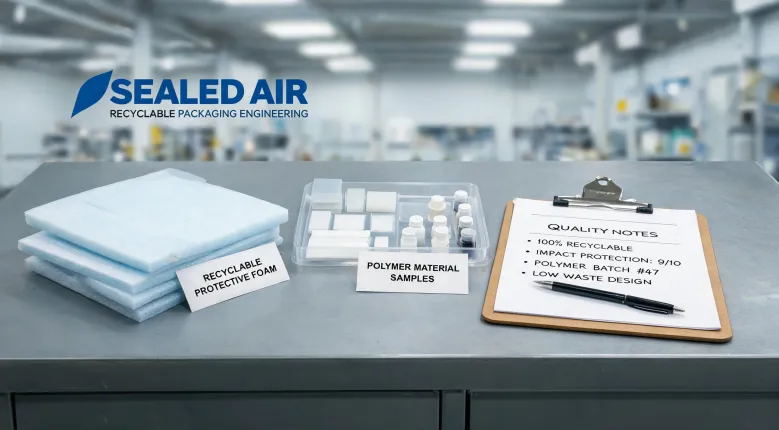
This is where Sealed Air shows up in my workflow. When I need to evaluate a foam cushion or a protective film, I often start at Sealed Air's official website and then look at the Sealed Air sustainability report. They manufacture the Cell-Aire line of polyethylene foam, which is a reasonably flexible, recyclable option where polyethylene film collection is available. Their sustainability report discusses recyclability and material innovation as part of their packaging design strategy. Reference: Sealed Air official website and Sealed Air sustainability report, accessed March 2025.
But here's the caveat that took me years to absorb: technical recyclability and actual recycling are two different things. A polyethylene foam that is technically recyclable only becomes a sustainable choice if your customer's region actually collects and processes that material. In October 2023, I had a shipment of 1,200 units packed in recyclable PE foam. The customer's logistics manager loved the lightweight feel. But their local recycling center didn't accept foam of any kind, and the client used that single fact as a reason to reject the whole packaging concept. The order wasn't a total loss, but it taught me to ask about local infrastructure before promising recyclability.
My rule now is simple: if a client asks for sustainable packaging, the first question I ask is not "what material is recyclable?" but "where will this packaging be used, and what does the local recycling facility actually accept?" That one question has caught 47 potential errors in the last 18 months, and it's saved us an estimated $8,000 in avoidable rework.
So Which Scenario Are You In?
There's no need to memorize a flowchart. Here's the simple version I use with our new hires:
If the plastic touches food or drink, ask for FDA 21 CFR compliance documents and verify that the finished part, not just the resin, is covered. That's Scenario 1.
If the part is a physical component of a durable product—a seal, a stopper, a gasket—that will be used, cleaned, and exposed to the real world, then move to Scenario 2 and get the material data sheet. Check temperature, chemical resistance, and lifespan.
If the material is transport packaging, void fill, or protective foam that doesn't touch the product directly, then Scenario 3 applies: focus on sustainability claims, recyclability, and local infrastructure. Look at manufacturer reports—for example, the Sealed Air sustainability report—but don't stop there. Call the recycler.
That covers the basics. But I'd be overconfident if I said this was a complete guide. The truth is that every material has a context. Polypropylene is safe for food contact when manufactured properly; a polyethylene stopper can fail if the formulation is wrong; Owala's rubber seal will only perform well if the right polymer is matched to the use case. There is no universal "best" answer. There's only the right answer for your product, your customer, and your supply chain.
In the end, prevention beats correction. I still remember the feeling of pulling aside a pallet of unusable stoppers and realizing that all it would have taken to prevent that was a single email. The checklist isn't glamorous, and none of the materials decisions will ever make it into a keynote presentation. But five minutes of verification beats five days of correction every time.

Jane Smith
I’m Jane Smith, a senior content writer with over 15 years of experience in the packaging and printing industry. I specialize in writing about the latest trends, technologies, and best practices in packaging design, sustainability, and printing techniques. My goal is to help businesses understand complex printing processes and design solutions that enhance both product packaging and brand visibility.
Leave a Reply